

Your buyers aren’t just Googling you anymore—they’re searching everywhere.
What happens before a buyer reaches out to your sales team? Spoiler: they’ve already done the research—and not just on Google.
Today’s B2B decision-makers are searching far and wide before you ever show up in their inbox or calendar. They’re asking ChatGPT for supplier recommendations. They’re watching YouTube walkthroughs. They’re validating you on Reddit threads and skimming thought leadership on LinkedIn.
And if your brand isn’t visible in those moments—across those channels—you’ve already lost the deal before the conversation even starts.
The Context: Search Behavior Has Shifted—Permanently
A decade ago, most marketers focused on one question: “How do we rank on Google?” And for good reason. Traditional SEO worked like a ladder—optimize your page, build links, climb higher.
But the search game has changed. According to Semrush, YouTube is now the second-largest search engine globally. Platforms like LinkedIn and Reddit have become knowledge hubs for peer-to-peer validation, while voice assistants like Siri and Alexa are quietly answering business-related queries in natural language. Meanwhile, AI tools like Claude and Gemini are no longer listing search results—they’re synthesizing answers based on brand visibility and structured content.
Buyers haven’t stopped searching. They’ve just changed how and where they do it.
In fact, a study by Influencer Marketing Hub found that 66% of marketers using AI-generated content saw improved campaign performance. But visibility wasn’t limited to Google rankings—it expanded to social media discovery, AI prompts, and voice-assisted search.
So, if you’re still betting everything on organic rankings, you’re playing a game that your audience has already moved past.
The New Imperative: Search Everywhere Optimization (SEO 2.0)
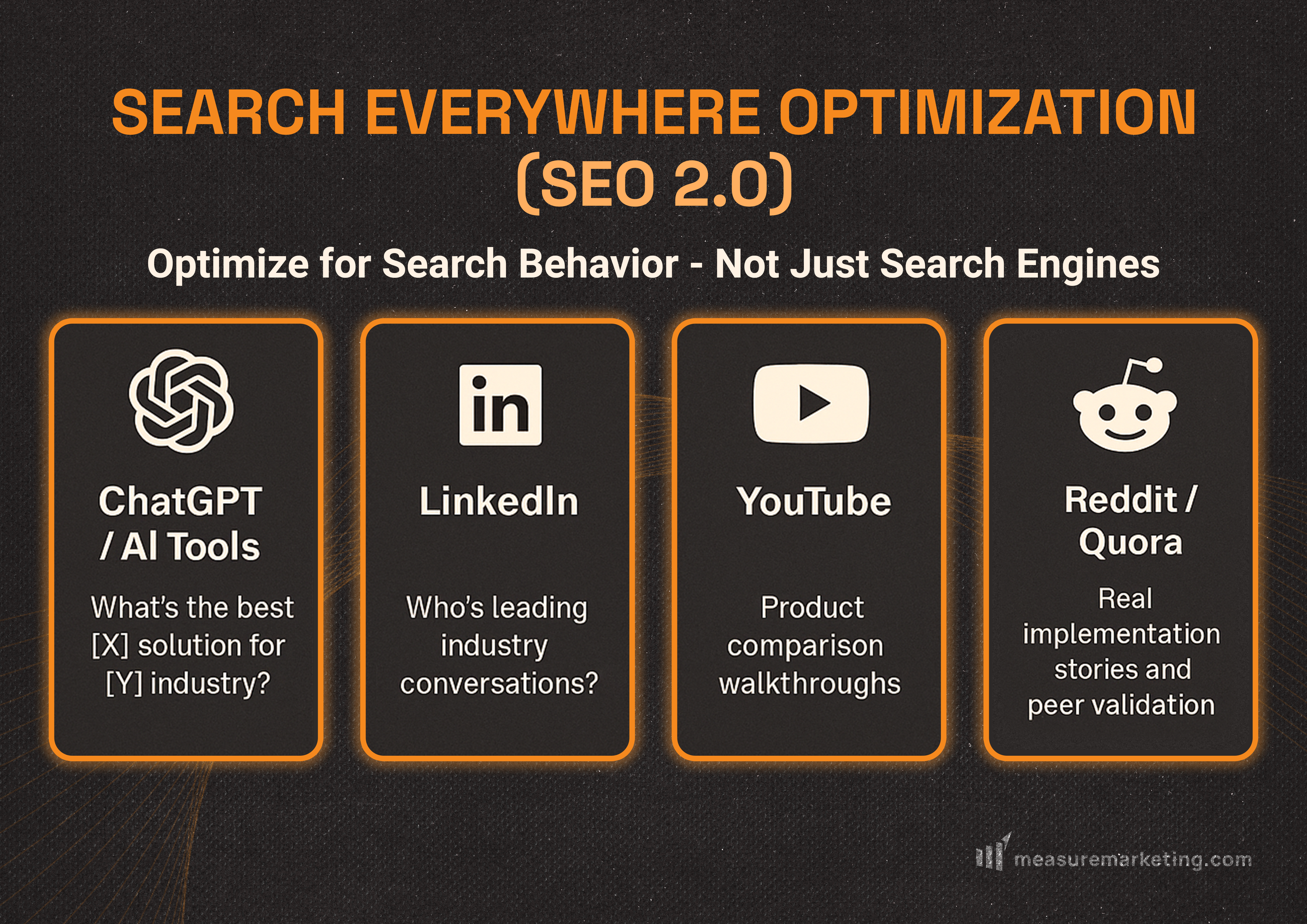
Think of it this way: you’re not just optimizing for search engines. You’re optimizing for search behavior.
Modern buyers might:
- Ask ChatGPT for “the best custom industrial parts suppliers in North America”
- Skim LinkedIn to see which companies are leading industry conversations
- Watch a YouTube video comparing product functionality
- Scroll Reddit or Quora for real-life implementation stories
If your content isn’t showing up in these micro-moments—on these platforms—it’s not part of the consideration set.
This is where Search Everywhere Optimization comes in. It’s about designing your digital presence for the fragmented, AI-augmented way people now discover solutions.
Make Your Content Work on Two Levels: Machines and Humans
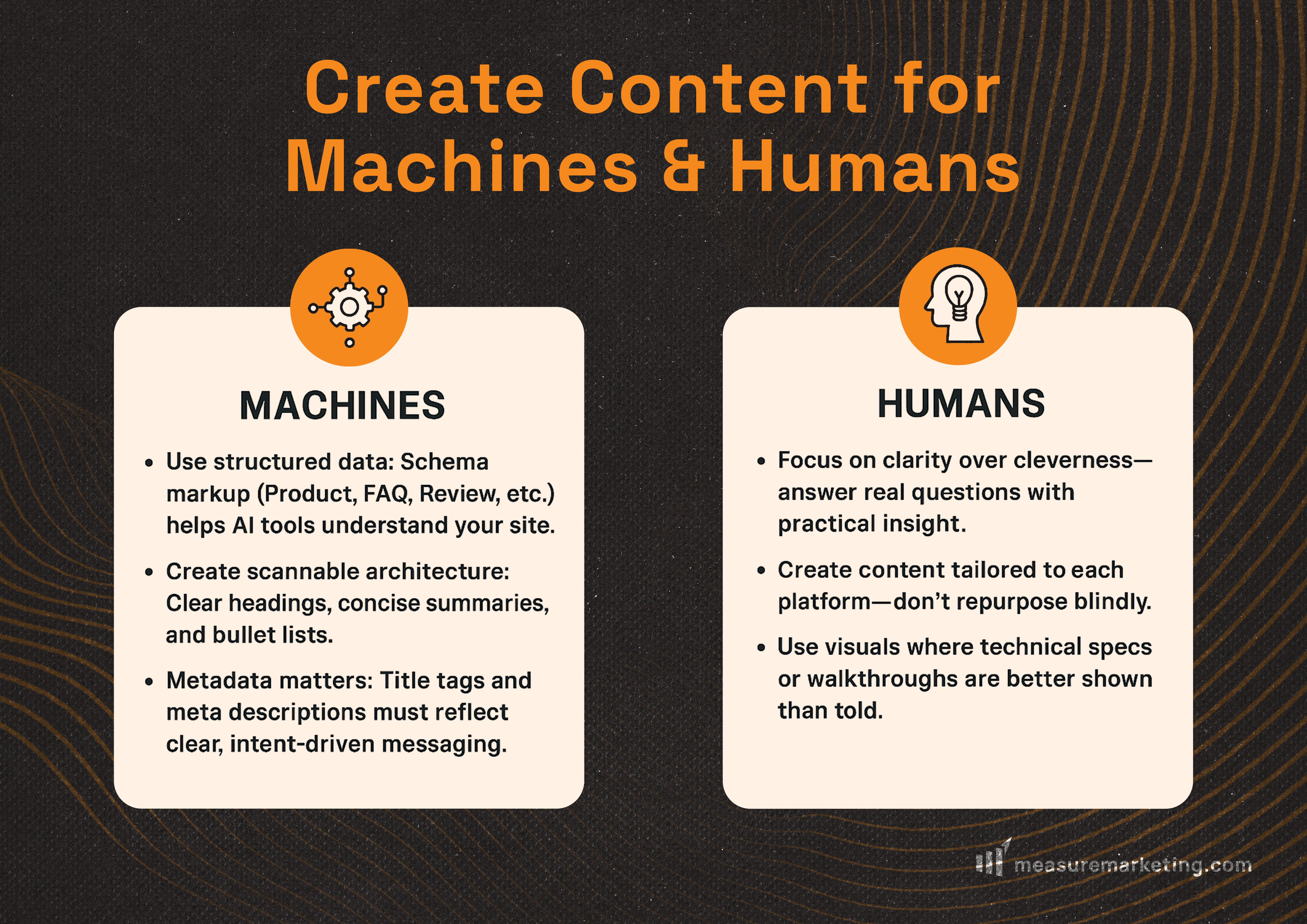
To thrive in this environment, your content must be both machine-readable and human-resonant at the same time.
For Machines (AI, Voice Assistants, Algorithms):
- Use structured data: Schema markup (Product, FAQ, Review, etc.) helps AI tools understand your site.
- Create scannable architecture: Clear headings, concise summaries, and bullet lists help with parsing and indexing.
- Metadata matters: Title tags and meta descriptions must reflect clear, intent-driven messaging.
Example: Want to appear in a voice search asking, “Who are the most reliable safety signage vendors near me?” You need schema, FAQs, and locally optimized metadata to even be in the running.
For Humans (Buyers, Referrers, Influencers):
- Focus on clarity over cleverness. Your videos, blog posts, and LinkedIn content should answer real questions with practical insight.
- Create content tailored to the platform—don’t repurpose blindly. A longform article doesn’t become a good carousel by simply copy-pasting.
- Use visuals where technical specs or walkthroughs are better shown than told.
From Video to Visibility: Applying Search Everywhere and AEO Principles
Neil Patel puts it simply: if your content only lives on your website, you’re invisible to a growing portion of your audience.
His studies for Search Everywhere Optimization (SEO 2.0) and Answer Engine Optimization (AEO) show what forward-thinking brands already know: buyers are interacting across AI tools, voice platforms, social feeds, and video channels before ever visiting a website.
Just look at NerdWallet. When they saw a 20% drop in organic traffic as users shifted to AI tools and alternative search surfaces, they didn’t just double down on Google. Instead, they optimized their content for visibility across Bing AI, ChatGPT, and social answer engines. The result? 37% revenue growth—proving that visibility in AI-driven, multi-channel ecosystems is now a growth lever, not just a traffic fix.
That’s what Patel means by meeting your audience everywhere they search. And it’s not just about reach—it’s about structure:
- Create platform-native content: short videos, carousels, FAQs, and how-tos
- Use schema markup so your content is machine-readable
- Provide concise, intent-driven answers that AI tools can summarize or surface
When someone asks ChatGPT, “Which financial platforms offer personalized credit advice?”, tools aren’t pulling from page one—they’re pulling from structured, trusted, AI-friendly content.
Rethinking Content’s Role in the Sales Funnel
Let’s make this practical: even if your leads still arrive through Request for Proposal (RFPs) or referrals, those buyers are searching you before replying to your email. That search might happen on Google—or it might happen through an AI tool, a peer forum, or a LinkedIn network.
And the first impression won’t be your proposal deck. It’ll be your search footprint.
Especially in high-trust industries such as manufacturing or industrial services, buyers want to minimize risk. They seek signals of credibility. And AI tools are increasingly trained to spot those signals—mentions in review sites, schema-rich web pages, FAQ content, industry certifications, and consistent thought leadership across platforms.
You can’t afford to let your distributor be your only public face. Your brand must stand independently visible, credible, and active in the very spaces buyers are searching.
Visibility Is the Trust Signal
This isn’t a content play—it’s a positioning one.
Buyers are no longer browsing in straight lines. They’re using AI to filter options, relying on peers for proof, and expecting answers on demand. If you’re not showing up across that discovery path—with structured, trustworthy, and platform-aware content—you’re not even part of the evaluation.
And in B2B, especially for manufacturers, that silence is costly. Because even if a deal starts with an RFP, the decision starts with a search.
Discover how visible your brand really is.
Take our Revenue Readiness Assessment and benchmark your content strategy against how real buyers—and intelligent systems—actually look for solutions today.
Let’s make sure you’re not just showing up. Let’s make sure you’re counted.