

For decades, the “go-to-market” strategy was tucked away in a neat little folder on the CMO’s desk. It was viewed as a marketing launch plan—a series of campaigns, some clever copy, and a budget for lead generation. In 2026, that traditional delegation is becoming a recipe for stagnation.
The truth is that go-to-market is not a marketing initiative, a sales campaign, or a departmental task. It is the fundamental system that defines how your company creates, captures, and delivers value to the marketplace. When a CEO treats go-to-market as something they can simply “check in on” during quarterly reviews, the organizational cost is staggering.
To build a company that scales predictably and efficiently, CEOs must lead go-to-market as a transformational process, rather than a one-time strategy.
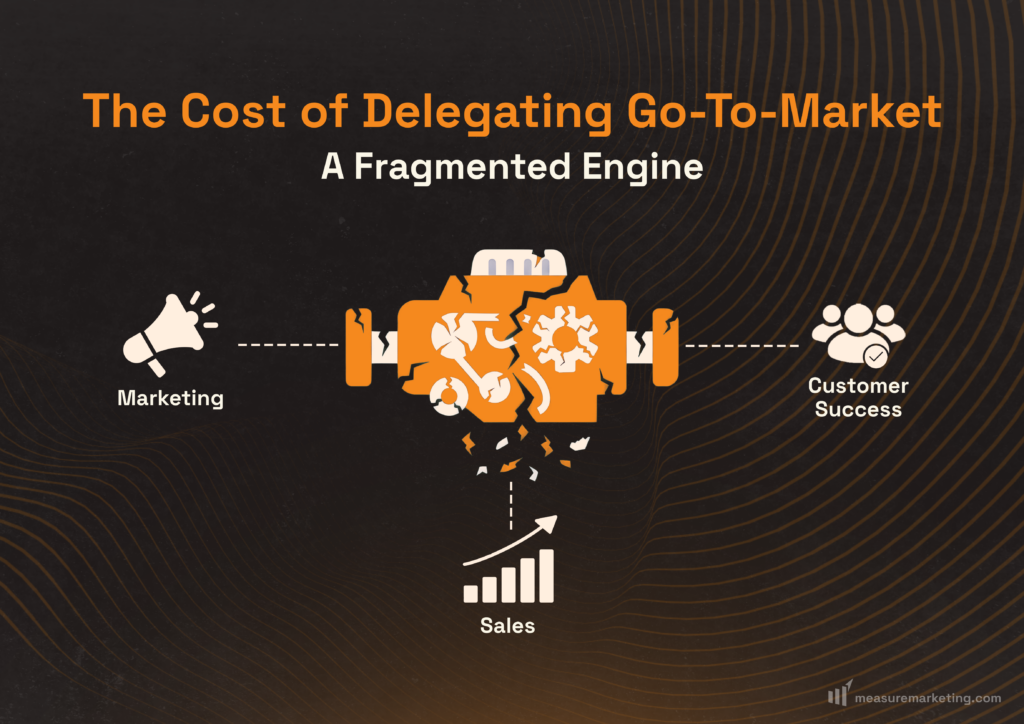
The Cost of Delegating Go-to-Market: A Fragmented Engine
When a leader steps back from go-to-market ownership, the vacuum is filled by departmental silos.
Marketing focuses on lead volume, Sales focuses on monthly quotas, and Customer Success focuses on tickets. None of these individual KPIs accounts for the holistic health of the revenue engine.
This fragmentation leads to “heroic efforts” from sales teams rather than repeatable, scalable plays.
The result is a series of growth setbacks that become increasingly expensive to ignore.
You may find your team reacting to market shifts rather than acting proactively. You might see churn eroding your hard-won gains because the post-sale experience doesn’t match the initial promise. Most dangerously, you lose the ability to forecast revenue predictably.
These aren’t just “marketing problems”—they are executive failures rooted in a lack of executive go-to-market alignment.
Where CEOs Typically Lose Visibility
Even the most involved leaders can lose sight of where their revenue engine is breaking down.
Across industries, we see consistent challenges that stall growth:
- The Last to Know: Being the last to enter deal cycles or struggling to move upmarket from SMB to Enterprise are symptoms of a weak strategic position.
- Value Wars: When teams struggle with “feature wars” or discounting, it is a sign that the go-to-market strategy hasn’t effectively quantified ROI for the customer.
- Disjointed Operations: Sales, Marketing, and Customer Success often operate out of sync, causing internal friction and external confusion.
What CEO-Owned Go-to-Market Looks Like in Practice
If you are the CEO, your role in go-to-market isn’t to write the social media copy or pick the CRM. Your role is to build a program that makes sustainable, scalable growth inevitable. This requires embracing five core principles of go-to-market transformation.
Systems Over Goals
Scalable growth requires repeatable, measurable systems—not just ambitious targets.
This is precisely why CEOs should own go-to-market. Only the CEO has the authority to bridge the gap between Sales, Marketing, Product, and Success.
By treating go-to-market alignment as the “North Star” of the company, you ensure that every department is moving toward the same objective. This shift from “setting goals” to “building systems” is the hallmark of a CEO’s role in revenue growth management.
Go-to-Market as a Continuous Process
Treating go-to-market as a static playbook is the fastest way to invite stagnation. It is an ongoing transformational process that must evolve as your business grows.
What worked at the “Problem-Market Fit” stage will likely fail you when you are chasing “Platform-Market Fit”.
Net Revenue Retention (NRR)
In 2026, the CEO must treat Net Revenue Retention (NRR) as the single most important indicator of long-term success.
If you can’t retain and expand your current customers, new acquisitions won’t sustain your growth. A CEO’s successful go-to-market strategy ensures that the “Renew and Expand” motion is just as prioritized as the “Market and Sell” motion.
Cross-Functional “One-Slide” Alignment
The CEO’s role in revenue growth is to ensure that go-to-market is the North Star of the entire company, not just a department.
This means boiling down the GTM strategy into a clear, integrated framework that unites sales, marketing, product, and operations on a single slide.
Efficiency Over Volume
A CEO-led go-to-market program focuses on quality, ROI-driven growth instead of the mindless pursuit of “more leads”.
It optimizes inbound, outbound, product-led, and event-led approaches to find the most efficient path to revenue.
Navigating the 5 Momentum Killers
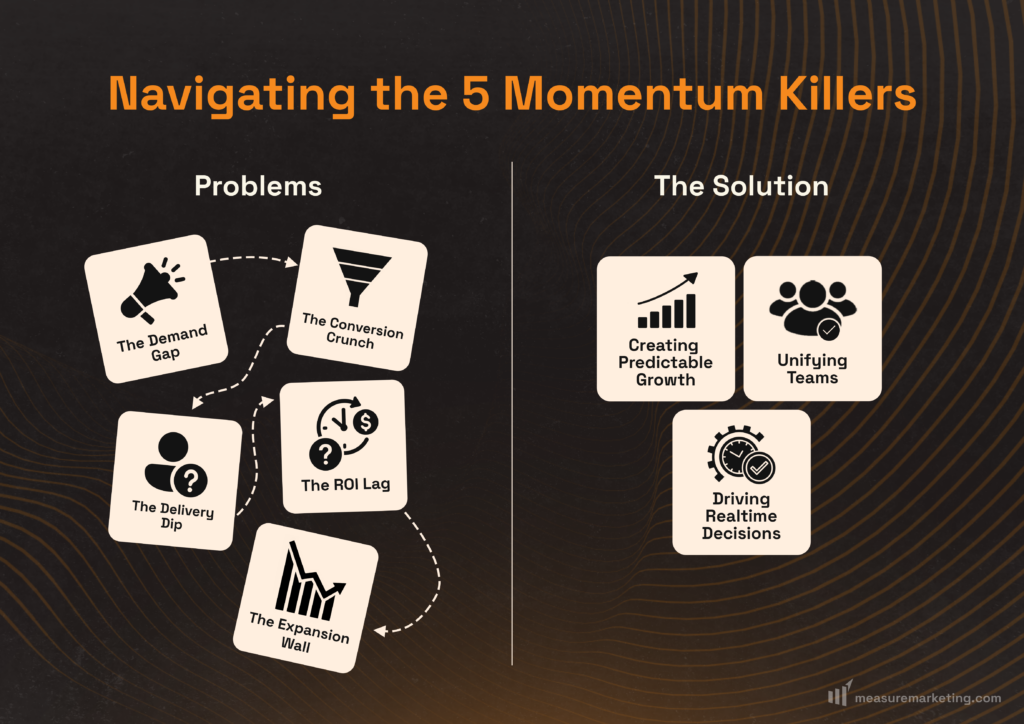
Even with a strong vision, momentum can stall at critical stages. Without an integrated go-to-market strategy, these “killers” often go unnoticed:
- The Demand Gap: You’ve launched a product but struggle to generate demand.
- The Conversion Crunch: You are generating demand but can’t close enough sales.
- The Delivery Dip: Customers buy, but delivery or onboarding falls short of expectations.
- The ROI Lag: Customers like the product but can’t quantify ROI, so renewals lag.
- The Expansion Wall: Customers renew, but you lack additional value to expand accounts.
As a strategist, your job is to diagnose which “killer” your business is currently battling and build a plan to move past it.
The Solution: A Unified Go-to-Market Program
Most companies approach growth as a collection of disconnected tactics, but at Measure Marketing, we use a structured framework that aligns all revenue-driving teams under one system—The Go-to-Market Program.
This program delivers transformation by:
- Unifying Teams: It eliminates silos and builds cross-functional executive go-to-market alignment.
- Creating Predictable Growth: It replaces ad-hoc targets with scalable processes.
- Driving Real-Time Decisions: It centralizes go-to-market data to guide executive action.
Taking Ownership of Your Go-to-Market Strategy
Transformation begins with a few practical, executive-level actions:
- Gather the Leadership: Sit down with your heads of Sales, Marketing, and Customer Success to identify the top 3-5 barriers you face together. This exercise alone builds alignment around the most pressing obstacles.
- Audit Your Planning: Look at your current planning process and identify the gaps in how your high-level strategy connects to day-to-day execution.
- Assess Maturity: Diagnose whether you are at the stage of Problem-Market Fit, Product-Market Fit, or Platform-Market Fit, and align your strategy accordingly.
- Act Now: CEOs must take ownership, lead cross-functional collaboration, and embed go-to-market into the fabric of their organizations.
Growth is Not an Accident
We believe growth is not an accident—it’s the result of intentional planning, aligned execution, and continuous optimization. This belief guides us when we partner with B2B SaaS, technology, and manufacturing companies to help them achieve measurable, sustainable growth.
We put great value on extreme ownership and take responsibility for results as if we were part of your internal team. We provide full-spectrum Revenue Generation services, from Go-to-Market Strategy to Digital Demand Generation, helping you build the roadmap to attract, convert, and retain your ideal customers.
Stop guessing your go-to-market plan. Start leading it.
Book a go-to-market strategy call with MMR today as your first step to building a system that makes lasting success inevitable.