

76% of marketers now use AI to improve their SEO outcomes. Is your SEO strategy future-ready?
The Next Era of SEO: Automated, Adaptive, and AI-Powered
In 2026, the fastest-growing SaaS brands won’t be the ones with deeper pockets—they’ll be the ones with smarter systems. Today’s SEO isn’t about manual inputs and static reports. It’s about AI agents working behind the scenes—analyzing SERPs in real time, anticipating search intent shifts, and modeling algorithmic changes before your competitors even notice.
This blog maps out how AI is reshaping SEO – what’s changing, which tactics deliver results, and how to build a more adaptive, performance-focused search strategy. If you’re leading a growth-focused SaaS brand, this is your playbook for building SEO that scales with precision.
How AI Is Changing SEO Workflows
Marketing teams are under pressure to move faster, scale smarter, and prove ROI more clearly than ever before. Traditional SEO workflows—spread across manual keyword research, content planning, technical audits, and link building—are struggling to keep up.
That’s where AI-driven SEO automation steps in.
Modern AI tools now handle everything from intent-based keyword clustering to SERP volatility monitoring and competitor performance analysis, streamlining tasks that used to take hours into just minutes.
Here’s what that looks like in action:
- Efficiency: Real-time audits, automated reporting, and dynamic optimization free up your team for strategic work.
- Accuracy: Machine learning models process far more search data than a human analyst can, identifying unseen patterns.
- Agility: NLP-driven tools surface content gaps and search opportunities based on live trends.
- Technical Precision: With technical SEO AI agents, backend issues like crawlability, schema errors, and site speed are identified and flagged before they hit rankings.
AI’s real value isn’t just automation—it’s augmentation. It transforms your SEO team into a performance engine that runs on smarter decisions, not guesswork.
Can AI Predict Google Algorithm Shifts?
Let’s clear something up: AI doesn’t predict Google updates like a crystal ball—but it does track the signals that precede them.
AI systems monitor thousands of ranking fluctuations, performance anomalies, and SERP feature changes across verticals. AI can flag early indicators of an algorithmic change by detecting deviations in traffic, ranking volatility, or engagement metrics—long before the impact is visible in traditional tools.
This concept is supported by peer-reviewed research. A paper from the IEEE International Conference on Big Data explains that by using AI to continuously monitor time-series metrics, organizations can “reliably detect issues… identifying early indicators of major problems before they become pervasive.”
In practice, that means your team isn’t reacting weeks later with emergency content fixes. You’re adjusting in real time—staying proactive, not reactive.

Top Use Cases for AI in SEO
So what does this look like on the ground? For scaling B2B SaaS companies, AI enables tactical advantages across the entire SEO funnel.
AI Agents for Keyword Research
Forget static keyword lists. AI agents now group keywords by search intent, buyer journey stage, and contextual relevance, not just volume. This approach builds smarter keyword maps that align with how real users think and buy.
Bonus: AI-driven SEO platforms can now auto-suggest content gaps based on real-time competitor movements.
Content Optimization
AI doesn’t just help you write faster—it helps you write better. AI-based on-page optimization tools now optimize content for readability, engagement, and semantic relevance, not just keyword stuffing. From sentiment analysis to visual formatting suggestions, these tools fine-tune content with surgical precision.
Backlink Analysis
Traditional backlink audits are slow and reactive. With AI, you can now detect toxic links, identify high-authority opportunities, and even predict the ranking impact of new backlinks using simulation. In short, link building using AI tools is becoming the new standard for defensible authority growth.
Technical Audits
Complex codebases and site architecture are no longer SEO blockers. With the best AI tools for SEO audits, you can automate diagnostics across schema, mobile UX, page speed, indexation, and more—in one unified dashboard.
And the results? They’re measurable.
According to recent industry data, brands that integrated AI into their SEO processes achieved a 50% reduction in time spent on data tasks and a 30% increase in campaign efficiency. More importantly, these companies reported tighter alignment between content strategy and user intent—resulting in smarter execution and faster growth.
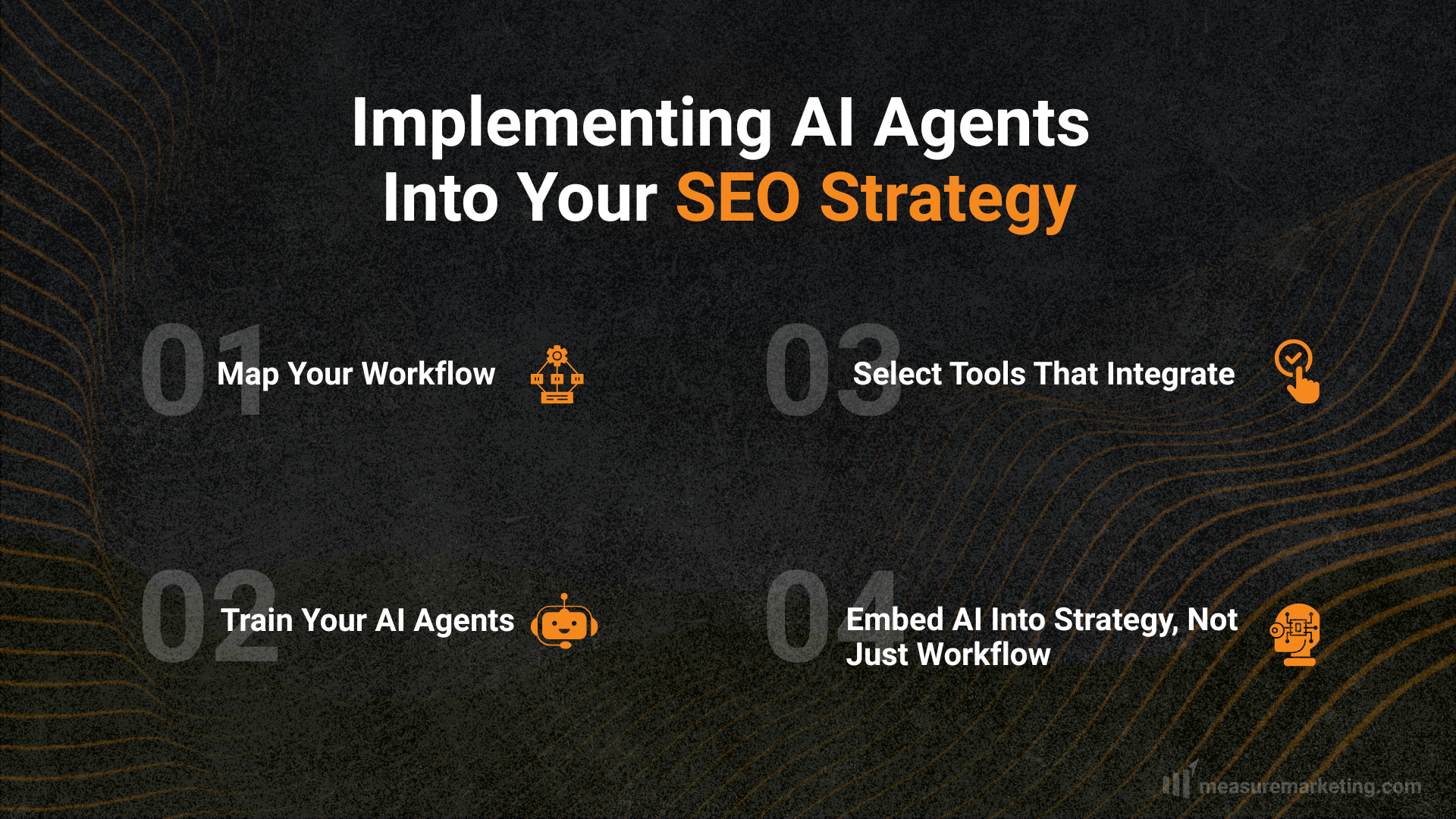
Implementing AI Agents Into Your SEO Strategy
Knowing the tools is one thing. Operationalizing them is where real competitive advantage happens.
Here’s a practical starting point:
1. Map Your Workflow
Identify slow points in your SEO pipeline—manual keyword research, reporting delays, backlog on technical fixes. These are your AI integration zones.
2. Select Tools That Integrate
Whether it’s for content generation, on-page, or AI-integrated crawler, choose solutions that work with each other, not in silos.
Pro tip: Redundancy kills momentum. Opt for platforms that allow real-time collaboration and automation from a single interface.
3. Train Your AI Agents
Don’t expect results out of the box. Feed them with labeled data—past performance metrics, CRM insights, and campaign feedback—to help them learn what success looks like in your context.
4. Embed AI Into Strategy, Not Just Workflow
AI isn’t a dashboard—it’s a partner. Use it to guide editorial planning, monitor rankings continuously, and iterate content based on live engagement metrics.
At Measure Marketing, our Demand Creation service helps B2B SaaS companies integrate AI-driven SEO frameworks into their growth strategy — combining real-time keyword intelligence, predictive analytics, and performance optimization to accelerate qualified pipeline growth.
Once your AI-enabled SEO framework is operational, the next step is to understand its broader impact. Integrating AI into your SEO and Demand Creation strategy goes beyond efficiency—it re-engineers how your search ecosystem performs at scale.
The Strategic Advantage of AI in 2026
This isn’t just about saving hours or cutting costs. This is about changing how your entire SEO engine works.
With AI fully integrated, your SEO becomes:
- More adaptive to search behavior and algorithm changes
- More precise in how it targets and converts traffic
- More accountable in measuring ROI and impact
And if you’re partnering with a go-to-market agency, they shouldn’t just use AI—they should architect strategies around it.
That’s exactly how the Measure Marketing team approaches growth through our GTM Strategy services — helping B2B SaaS brands align marketing, sales, and RevOps under a unified, AI-powered go-to-market engine. As a B2B SaaS SEO agency, we go beyond automation. We design intelligent SEO ecosystems tailored to your revenue goals.
Want to See How AI-driven SEO Fits Your B2B SaaS Growth Plan?
Let’s map your current challenges to high-leverage, AI-supported solutions. No fluff—just real pathways to performance.