

The Shift: Why “Growth at All Costs” is Over
For the last decade, the B2B mantra was simple: Acquire, acquire, acquire. Sales teams were celebrated for ringing the bell, while customer success was often viewed as a cost center—a support function just there to put out fires.
But the economic winds have shifted. According to recent industry data, Customer Acquisition Costs (CAC) have risen by nearly 60% over the last five years. The era of “cheap growth” is dead.
In this new landscape, a robust customer retention strategy isn’t just a safety net against churn; it is your most efficient path to revenue. The math is undeniable: it costs anywhere from 5 to 25 times more to acquire a new customer than to retain an existing one.
Retention is the new acquisition.
Why Customer Marketing Matters for Revenue Growth
In the B2B world, specifically in SaaS, the initial sale is often just the starting line. The real profit is made in years two, three, and four. This is where customer marketing for B2B SaaS becomes critical.
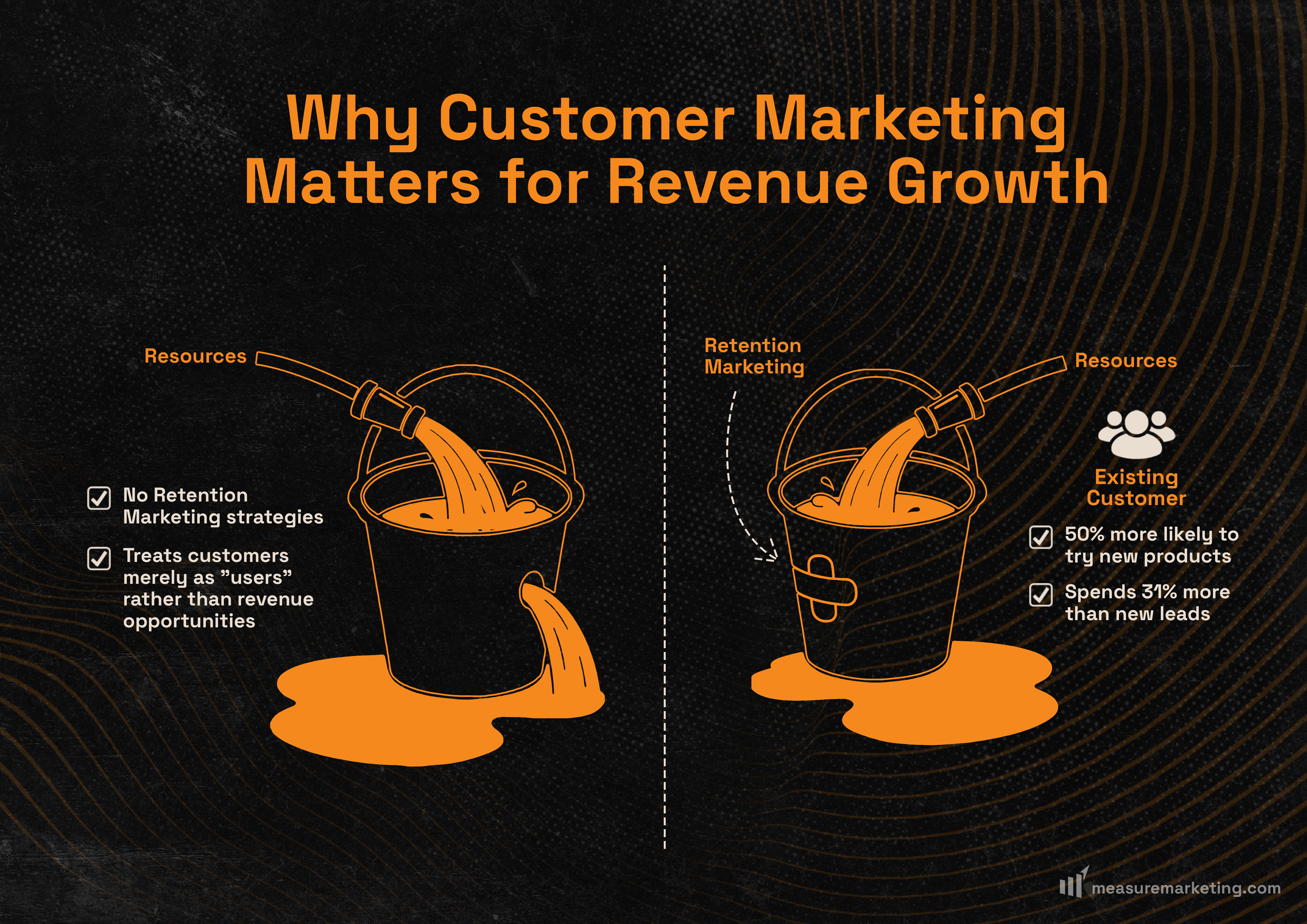
If you treat your customers merely as “users” rather than revenue opportunities, you are leaving money on the table. Existing customers are 50% more likely to try new products and spend 31% more than new leads.
When you prioritize retention marketing, you flip the funnel. Instead of pouring resources into a leaky bucket, you seal the holes and use your existing base to fund your growth. This drives Net Revenue Retention (NRR)—the golden metric that measures how much your revenue grows from the existing base alone (upsells + cross-sells – churn).
Tactics to Operationalize Customer Retention
Great retention doesn’t happen by accident. It requires the same level of rigor, segmentation, and automation as your outbound sales strategy. Here are three key levers for customer experience optimization:
Segmentation Before Personalization
One of the biggest pitfalls in B2B retention is treating every customer the same. A “whale” account needs a different journey than a self-serve user.
- The Tactic: Use your CRM data to segment customers not just by size, but by health score and feature adoption.
- The Play: Build distinct automated tracks. High-health customers get “Expansion” campaigns (upsell offers). Low-health customers get “Rescue” campaigns (educational content and CSM intervention).
Activate NPS Loops (Don’t Just Measure, Act)
Many companies send Net Promoter Score (NPS) surveys, look at the score, and move on. That is a wasted opportunity.
- The Tactic: Build automated workflows based on responses.
- Promoters (9-10): Trigger an immediate request for a testimonial or referral.
- Detractors (0-6): Immediately alert the Account Manager. Speed to response is the #1 factor in saving these accounts.
CX Automation for Onboarding
Churn often happens in the first 90 days because value wasn’t demonstrated quickly enough.
- The Tactic: Map out the “First Value” milestone. Automate the handoff from Sales to CS to ensure no data is lost, and use email automation to guide the user to that first “aha!” moment without manual intervention.
Measuring Success: CLV and Expansion
To turn retention into a revenue engine, you must measure the right metrics. While “Churn Rate” tells you who left, it’s a lagging indicator. To look forward, focus on Customer Lifetime Value (CLV).
CLV = (Average Purchase Value × Purchase Frequency) × Average Customer Lifespan
How to turn customer retention into a revenue engine: Stop looking at marketing ROI solely through the lens of new leads. Start attributing revenue to expansion campaigns. If a marketing email drives an existing account to add 5 new seats, that is marketing-attributed revenue.
By tracking CLV and Expansion Revenue, marketing can prove its value beyond the initial contract signature.
Stopping the Leaky Bucket of a B2B SaaS
Consider a mid-sized B2B SaaS platform in the logistics space. They were growing their new logo count by 20% YoY, but their revenue was flat.
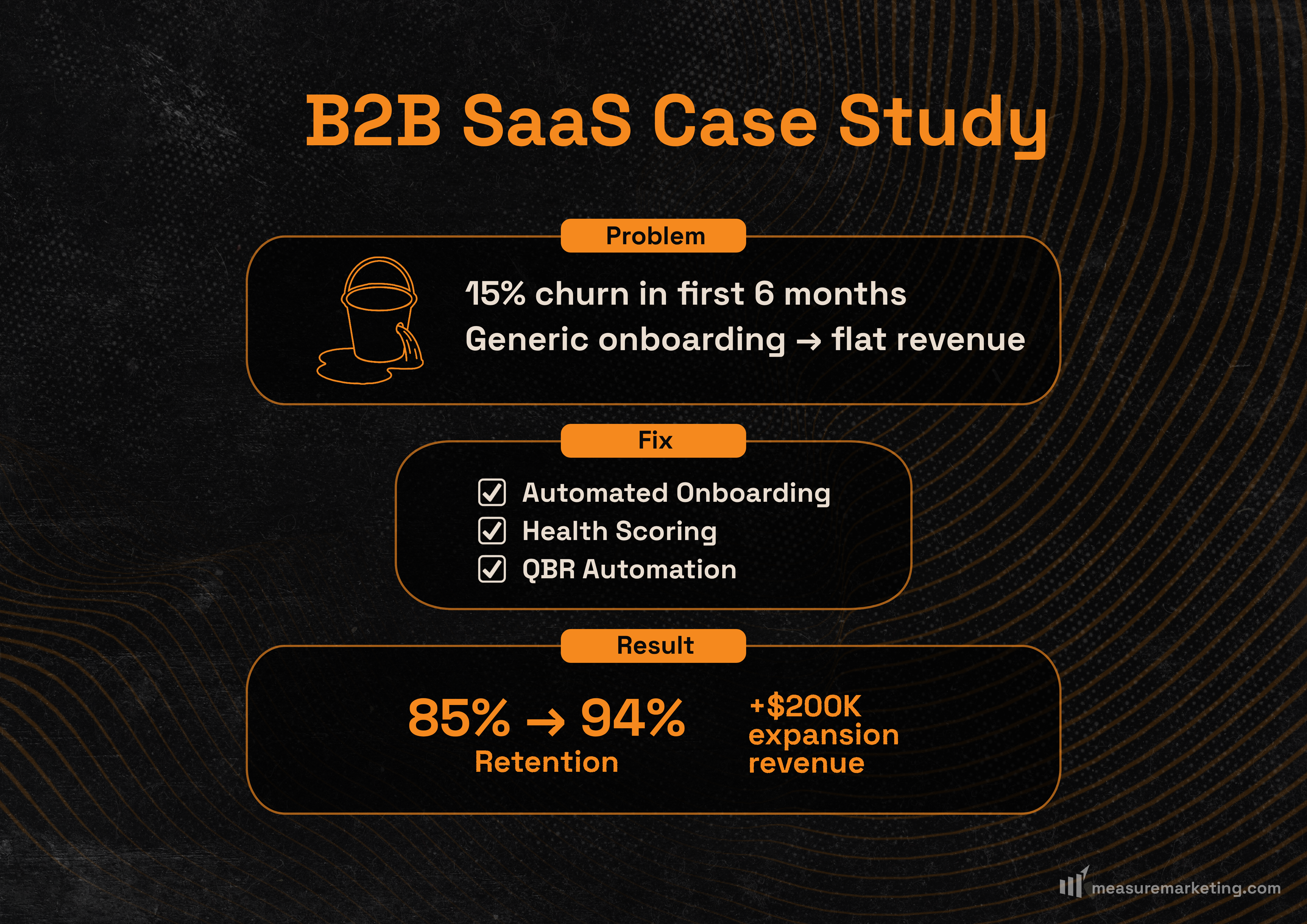
The Data Story: They partnered with Measure Marketing to audit their revenue engine. The diagnosis was stark: they had a “leaky bucket.” While sales were bringing in customers, 15% were churning within the first six months. The culprit? A “generic” onboarding experience that failed to address specific user goals.
The Fix: Measure Marketing helped them implement a retention-focused RevOps play:
- Automated Onboarding: They built a 6-week automated email journey triggered immediately upon contract signature, guiding users through setup steps that were previously manual.
- Health Scoring: They set up alerts in their CRM. If a key decision-maker stopped opening emails, the account was flagged as “At Risk.”
- QBR Automation: Automated reminders were set up 90 days before renewal to schedule Quarterly Business Reviews, ensuring no renewal came as a surprise.
The Result: Within two quarters, 6-month retention improved from 85% to 94%. More importantly, the SaaS retention marketing strategies implemented paved the way for a cross-sell campaign that added $200k in expansion revenue from the saved cohort.
Turn Retention Into Growth
Is your marketing team focused exclusively on the top of the funnel while the bottom of the funnel leaks revenue? It’s time to rebalance.
Customer retention strategy is the most reliable engine for sustainable growth. Don’t let your hard-won customers slip away.
At Measure Marketing, we help you operationalize the entire customer lifecycle—from acquisition to advocacy.
Contact us today to learn how we can help you measure, optimize, and grow your Customer Lifetime Value.