

For the better part of a decade, the standard playbook for B2B SaaS growth relied on volume. More leads, more onboarding emails, more SDR outreach, more campaigns. It worked when the buying journey was linear, and teams could compensate for gaps with headcount.
Today, that model is showing its limits.
Buyers move differently. The funnel has fractured. Revenue teams are navigating record levels of noise, more channels, more data, more expectations, and fewer clear signals.
Across our GTM assessments at MMR, we see the same pattern:
Teams are not failing because of effort.
They are failing because the system is overloaded.
This is the context in which Artificial Intelligence has shifted from an emerging capability into a foundational element of the modern go-to-market engine. Not as a trend or a shortcut, but as the connective part that helps revenue teams operate with greater clarity, consistency, and precision.
This guide outlines how AI is reshaping GTM strategy for B2B SaaS companies and what leaders can do to modernize their revenue systems in practical, measurable ways aligned with real operational needs.
Why Traditional GTM Models Are Breaking Down
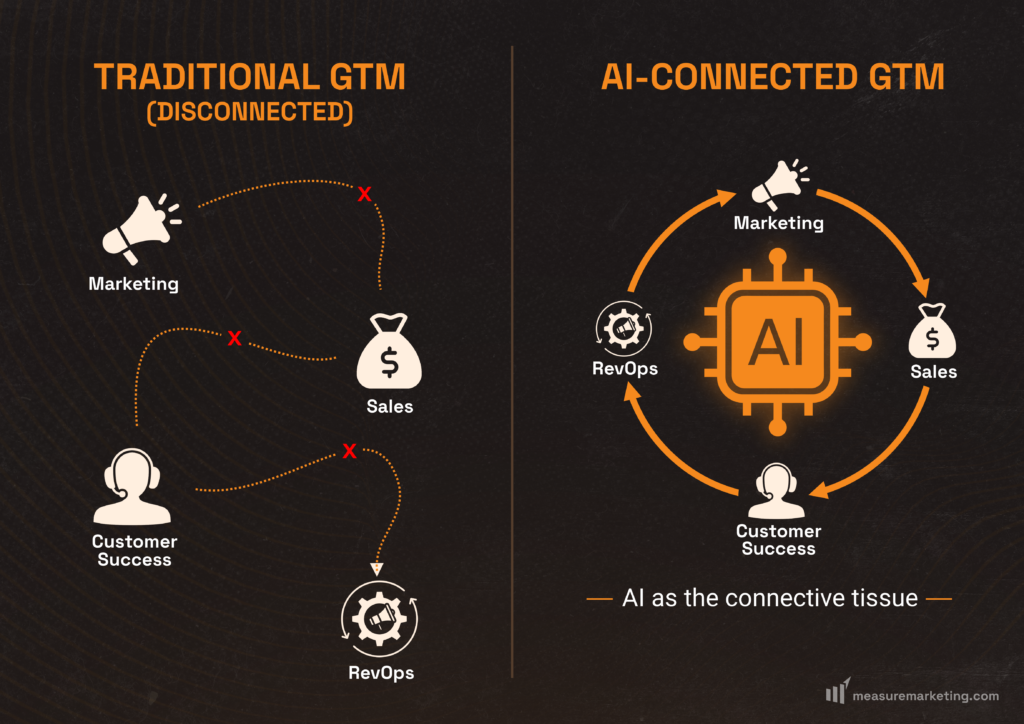
Most SaaS revenue engines were designed for a different era. Marketing generates awareness, hands leads to sales, and sales hands customers to CS. At each step, information is exchanged, often imperfectly, and each team optimizes for its own metrics.
It is difficult to scale a system built on handoffs when buyers no longer move in a straight line. Engagement happens earlier, silently, and across multiple channels. Sales conversations begin long after research has started. Post-sale insights rarely make their way back into marketing. And RevOps often carries the burden of connecting disparate systems.
The result is a GTM model in which teams work hard but operate without the shared intelligence needed to generate predictable revenue. AI helps address this not by replacing these teams, but by strengthening the connective tissue between them.
How AI Elevates GTM Motions
In studying how leading organizations are adopting AI, a consistent theme emerges:
The greatest value is not automation, it is interpretation.
AI helps teams identify patterns in buyer behavior, surface insights earlier, and personalize engagement in ways that manual processes cannot sustain. Its impact is not in replacing work, but in elevating the work teams are already doing.
For marketing, this means creating content and campaigns that respond to intent and behavior, not just broad personas.
For sales, it means focusing on higher-intent accounts with clearer context and better preparation.
For customer success, it means visibility into signals that indicate risk or opportunity long before renewal cycles begin.
In each case, AI supports the same goal: reducing guesswork and increasing relevance.
The Shift Toward Predictive, Customer-Obsessed GTM
Forrester describes the next evolution in GTM as a shift from “customer centricity” to “customer obsession.” This means not only responding to customer needs, but anticipating them.
AI makes this shift executable.
By analyzing patterns in engagement, content consumption, product usage, and communication, AI helps GTM teams understand where a buyer is in their internal process, not just the company’s funnel. It narrows the gap between what the customer expects and what the company delivers.
This is the advantage:
Less friction, earlier alignment, and more informed GTM decisions across every stage of the journey.
Building the AI-Enabled GTM Engine
The organizations seeing meaningful returns from AI share a common structure:
They build their GTM engines around alignment first, technology second.
It begins with a foundation of clean data, clear lifecycle definitions, consistent processes, and shared operational rhythms. These are the elements that determine how well AI can interpret signals and produce reliable insights.
From there, teams layer AI into their workflows to enhance, not replace, team capabilities. Marketing improves segmentation and personalization. Sales benefits from stronger prioritization and contextual insights. CS gains predictive visibility into risk and expansion opportunities.
The result is a revenue system that is more unified and more adaptive, powered by a shared intelligence layer rather than isolated tools.
Implementing AI Through the ARISE Framework
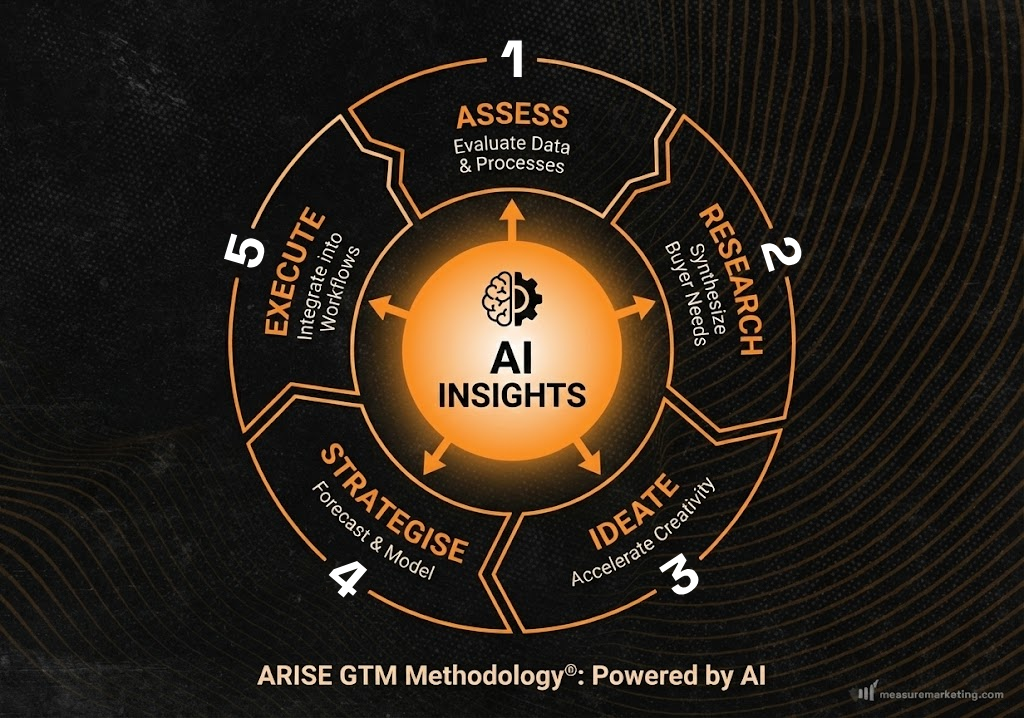
To help organizations adopt AI in a structured, sustainable way, MMR uses the ARISE GTM Methodology®, a practical five-stage framework:
- Assess: Evaluate the current state of your GTM engine, data hygiene, funnel performance, content inventory, and process alignment. AI cannot correct what is structurally unclear.
- Research: Use AI to accelerate understanding. Instead of manually reviewing customer feedback or call transcripts, AI quickly synthesizes themes, objections, and patterns, helping teams work from a clearer picture of real buyer needs.
- Ideate: Generative AI accelerates the creative process. It helps teams explore messaging angles and produce variations for testing without starting from scratch, improving creativity and speed without sacrificing strategy.
- Strategise: Use AI-informed insights to forecast outcomes, model scenarios, and set more realistic targets. This allows leadership to make decisions grounded in evidence rather than solely on intuition.
- Execute: Integrate AI into daily workflows, content refinement, campaign adjustments, and pipeline prioritization to make the GTM engine progressively more adaptive and consistent.
Why Governance Determines AI Success
As AI becomes more embedded in GTM systems, governance becomes a non-negotiable foundation.
This includes:
- Clear standards for how AI outputs are reviewed
- Strong data hygiene practices
- Consistent human oversight
- Understanding where AI adds value and where human judgment remains essential
Forrester emphasizes balancing innovation with governance.
The organizations that succeed will be those that apply AI responsibly, ensuring accuracy, security, and trust across the revenue engine.
Conclusion: Intelligence as a GTM Advantage
The next era of B2B SaaS growth belongs to organizations that combine human strategy with AI-enabled insight. When GTM teams operate from a unified intelligence layer, they make better decisions, move faster, and meet buyers with relevance rather than volume.
AI does not replace the fundamentals of good GTM.
It strengthens them.
It creates clarity where teams once had noise.
AI builds a revenue engine that learns, adapts, and improves continuously.
At Measure Marketing Results, we help B2B SaaS organizations move from experimentation to execution, turning AI into a measurable driver of GTM performance, alignment, and revenue predictability.
Ready to modernize your GTM engine?
Connect with the MMR Strategy Team to begin your AI-enabled GTM transformation or take our 5-minute Revenue Readiness Assessment.