

The CMO’s Budget Squeeze: Doing More with Less
A business-first approach blog about maximizing marketing budgets. From 9.1%, marketing budgets are now down to 7.7%. That is the stark reality facing today’s Chief Marketing Officers.
Yet, while resources have shrunk, expectations have not. Boards still demand double-digit growth, and marketing is expected to “do more with less.” As experts have noted, marketing is typically first in line for cuts and last in line for increases during economic uncertainty.
You are tasked with driving revenue and navigating a complex digital landscape—while defending every single dollar. This “budget squeeze” forces a critical choice:
- Do you keep chasing the newest, shiniest technology?
- Or do you anchor your strategy to clear, measurable business outcomes?
To survive and thrive, a business-first marketing strategy is no longer just a smart idea; it is essential. It requires a shift in mindset: building a framework that prioritizes the revenue engine over the tool stack.
Business-First vs. Tech-First: A Tale of Two Strategies
Too many marketing departments still fall into the “tech-first” trap.
The Tech-First Approach (The Trap)
The thinking goes: “If we just buy that new ABM platform, CDP, or AI content tool, we’ll finally fix our pipeline.” This strategy is reactive. You buy a tool, then build your strategy around the tool’s features.
It feels like progress, but it often leads to bloated martech stacks, low adoption, and “shelf-ware” that quietly consumes budget.
A recent study found that despite global spend reaching nearly $160 billion, many leaders still struggle to quantify how their investments drive revenue because they are stuck tracking superficial engagement metrics rather than business outcomes.
The Business-First Approach (The Solution)
A business-first approach is proactive. It starts with fundamental questions—the kind you see in a board deck, not a martech demo:
- What are the overarching growth goals for the next 1–3 years?
- Are we trying to increase market share, enter a new vertical, reduce CAC, or grow CLV?
- Where are the real bottlenecks in our revenue funnel?
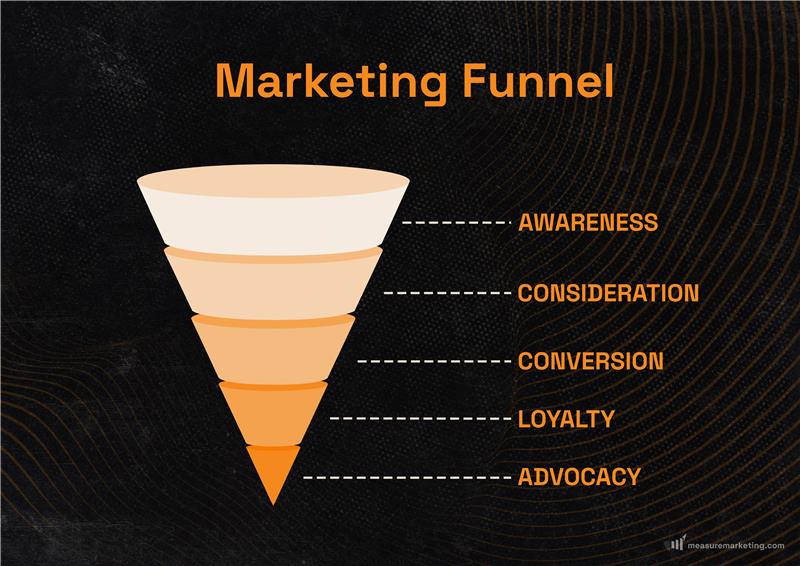
Only once you have data-backed answers to these questions can you start making strategic budget allocation decisions. Technology then becomes what it was always meant to be: an accelerant to a sound strategy, not a substitute for one.
The Framework: Align Spend to Pipeline Velocity
A core component of marketing budget optimization is measuring what actually moves revenue. For years, marketing has leaned on vanity metrics like social impressions and raw MQL volume. Useful? Sometimes. Board-ready? Almost never.
To maximize ROI, you must tie every dollar of spend to Pipeline Velocity—a metric that Revenue Operations (RevOps) teams and modern CROs use as a single “line of sight” into performance.
Pipeline Velocity = (Number of SQLs × Average Deal Value × Win Rate %) ÷ Sales Cycle (in days)
When you align your budget to these four levers, you understand exactly how to align marketing budgets with business growth goals:
- Problem: Not enough SQLs.
- Strategic Response: Reallocate spend from broad awareness to high-intent, bottom-of-funnel activities (e.g., targeted webinars, competitor comparison pages).
- Strategic Response: Reallocate spend from broad awareness to high-intent, bottom-of-funnel activities (e.g., targeted webinars, competitor comparison pages).
- Problem: Low Average Deal Value.
- Strategic Response: Fund a strategic ABM pilot targeting high-value enterprise accounts instead of high-volume/low-value content syndication.
- Strategic Response: Fund a strategic ABM pilot targeting high-value enterprise accounts instead of high-volume/low-value content syndication.
- Problem: Low Win Rate.
- Strategic Response: Invest in better enablement and RevOps hygiene—cleaner data, ICP scoring, and coordinated plays between marketing and sales.
- Strategic Response: Invest in better enablement and RevOps hygiene—cleaner data, ICP scoring, and coordinated plays between marketing and sales.
- Problem: Long Sales Cycle.
- Strategic Response: Invest in mid-funnel assets (ROI calculators, buying guides) that help internal champions de-risk the decision for stakeholders.
Case Example: Reallocating for Real B2B Marketing ROI
Consider a B2B SaaS company that was spending 60% of its budget on top-of-funnel content and Google Ads. They hit their MQL target every quarter. On paper, marketing looked “successful.” But sales were starving.
The Problem: An internal audit found a glaring bottleneck. The MQL-to-SQL conversion rate was below 1%. Sales complained the leads were “junk,” and Marketing insisted sales “weren’t working their leads.”
The Strategic Reallocation: Instead of buying a new lead-scoring tool to fix the symptoms, the company partnered with Measure Marketing to address the root cause. Together, they redefined the Ideal Customer Profile (ICP) and realized the targeting was simply too broad. They advised cutting broad Google Ads spend by 50% and reallocating that capital to:
- A hyper-targeted LinkedIn campaign focused on three key job titles in two high-value industries.
- A “State of the Industry” research report used as a flagship asset for outbound sales.
- A simple RevOps pod to review funnel health quarterly.
The Result: Over the next six months, total MQLs dropped by ~40%. However, SQLs tripled, and sales-accepted pipeline value grew by ~80%. This case study perfectly illustrates the art of maximizing ROI in B2B SaaS marketing: cut low-value activity to protect the programs that demonstrably move revenue.
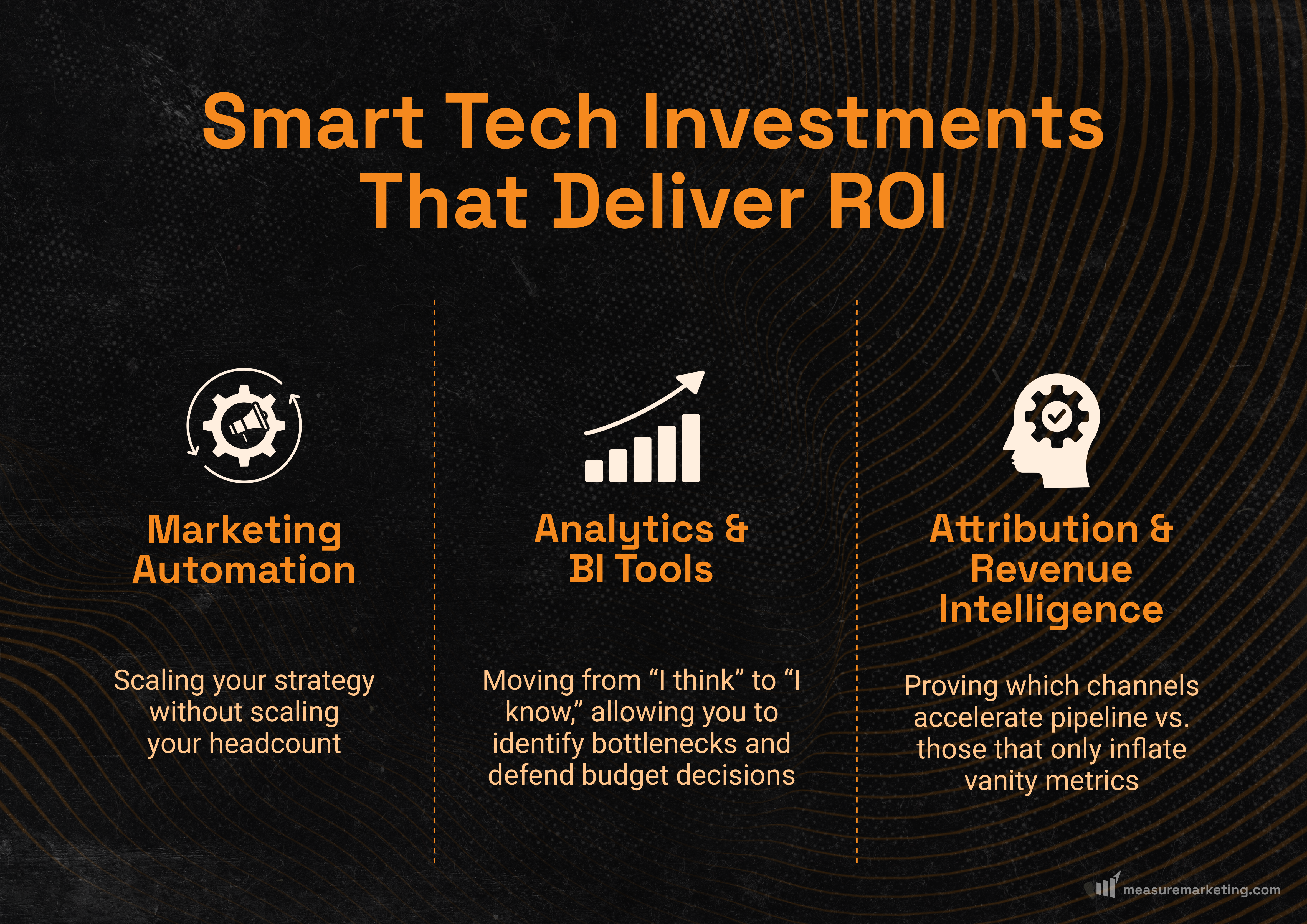
Smart Tech Investments That Deliver ROI
Once your business-first strategy is set, technology becomes a force multiplier. Here are three categories that deliver outsized B2B marketing ROI when deployed correctly:
- Marketing Automation: Platforms (like HubSpot or Marketo) that orchestrate journeys based on behavior and fit.
- The ROI: Scaling your strategy without scaling headcount.
- The ROI: Scaling your strategy without scaling headcount.
- Analytics & BI Tools: Your “truth system” (like Tableau or Power BI).
- The ROI: Moving from “I think” to “I know,” allowing you to identify bottlenecks and defend budget decisions.
- The ROI: Moving from “I think” to “I know,” allowing you to identify bottlenecks and defend budget decisions.
- Attribution & Revenue Intelligence: Tools that link the first touch to closed-won revenue.
- The ROI: Proving which channels accelerate pipeline vs. those that only inflate vanity metrics.
Build Your Strategy, Then Your Tech Stack
Stop letting “shiny object syndrome” dictate your budget. The most profound budget optimization doesn’t come from a new piece of software; it comes from a new operating model:
- Start with business outcomes (growth targets, CAC, CLV).
- Adopt revenue-centric metrics (Pipeline Velocity).
- Embed RevOps principles (unify data and process).
- Then choose technology to accelerate what works.
Done well, marketing stops looking like a discretionary cost center and starts behaving like a predictable, data-driven growth engine.
Start building a business-first framework for predictable growth.
At Measure Marketing, we help marketing leaders bridge the gap between strategy and execution. Contact our team today for a complimentary Marketing ROI Review, and let’s identify the best opportunities to align your spend with your growth goals.