

The factory floor isn’t the only thing that’s changed. Your buyer has, too. In 2025, North American manufacturers can no longer thrive on traditional sales tactics alone. This guide is your full-funnel blueprint—a comprehensive industrial content marketing checklist designed to attract, engage, and convert the modern, digitally savvy B2B buyer, fueling measurable, profitable growth.
The manufacturing world across North America is changing fast. This shift is not because of new machines on the factory floor – it’s because of a new kind of buyer. Today’s B2B decision-makers do most of their research online long before they ever talk to a sales rep. In fact, Gartner found that 79% of B2B buyers visit supplier websites at every stage of their buying journey.
For manufacturers, that means your digital presence matters just as much as your physical one. A strong content marketing strategy isn’t a “nice-to-have” anymore – it’s the growth engine that fuels visibility, trust, and long-term success in 2025’s competitive B2B landscape.

About Manufacturing Marketing
Manufacturing marketing is a strategic approach focused on creating and distributing valuable, relevant, and consistent messages to attract and retain a clearly defined audience. The ultimate goal? To drive profitable customer action. Strategic content marketing plays a crucial role in reaching the right audience at the right time.
This isn’t about the hard sell. It’s about establishing your company as a trusted authority and an indispensable resource. By consistently educating engineers, production managers, and procurement officers with expert insights, you build the credibility needed to shorten complex sales cycles and foster long-term loyalty.
Why Content Strategy Is Crucial for Industrial Manufacturing
A decade ago, marketing for a manufacturer might have been limited to glossy brochures, trade show booths, and a firm handshake. Today, that playbook is obsolete. The buyer’s journey is no longer linear; it’s a complex, self-directed path powered by instant access to information. Modern buyers expect personalized, digital-first experiences.
This is especially true for distribution-driven manufacturing businesses, where complex partner channels add another layer to the sales process. A clear content strategy for such manufacturing companies ensures your message remains potent and consistent, whether an end-user, a distributor, or an internal stakeholder is consuming it. It’s the shift from broadcasting product features to building unshakable trust through expertise.
The impact of this shift is hard to ignore. We find that several mid-sized B2B manufacturers are struggling to generate new business and move prospects through long, complex sales cycles. By refining their target audience, outsourcing front-end sales development, and implementing smarter CRM systems, they created a more efficient, trust-driven sales process. Within months, they saw measurable growth — adding over a million dollars in new account revenue and dramatically improving conversion velocity year over year.
2025 Checklist for Manufacturing Content Marketing
Here’s how to create a content strategy that drives results for manufacturers in 2025. This checklist is your blueprint for building a high-performance content engine.
Map Content to the Customer Journey
Your buyers aren’t a monolith. A manufacturing engineer seeks technical specs, a production manager needs ROI data to justify a capital expenditure, and a procurement officer is focused on value and vendor reliability. Effective customer journey content mapping for B2B involves creating tailored content that addresses the unique pain points of each persona at every stage of their decision-making process.
Create Evergreen Content That Ranks
While timely content has its place, the foundation of a strong strategy is evergreen content—high-value, in-depth resources that remain relevant for years. Think ultimate guides, comprehensive white papers, and detailed case studies. This type of authoritative content not only builds trust but also consistently performs well in search rankings, delivering sustainable organic traffic and long-term value.
For example, a custom tooling company might want to create highly technical content detailing spindle repairs. This content can directly target engineers searching for solutions to niche problems, establishing the company as the go-to expert and generating highly qualified leads for years to come. Any organization that wants to establish authority must think about what would make its content valuable to its prospects.
Tell Stronger Product Stories
Technical specs are essential, but they don’t inspire action on their own. The best manufacturing brand storytelling strategy translates complex features into compelling benefits. Frame your products as solutions to your customers’ biggest challenges. Effective product storytelling in manufacturing isn’t about what your product is; it’s about what it enables your customer to do.
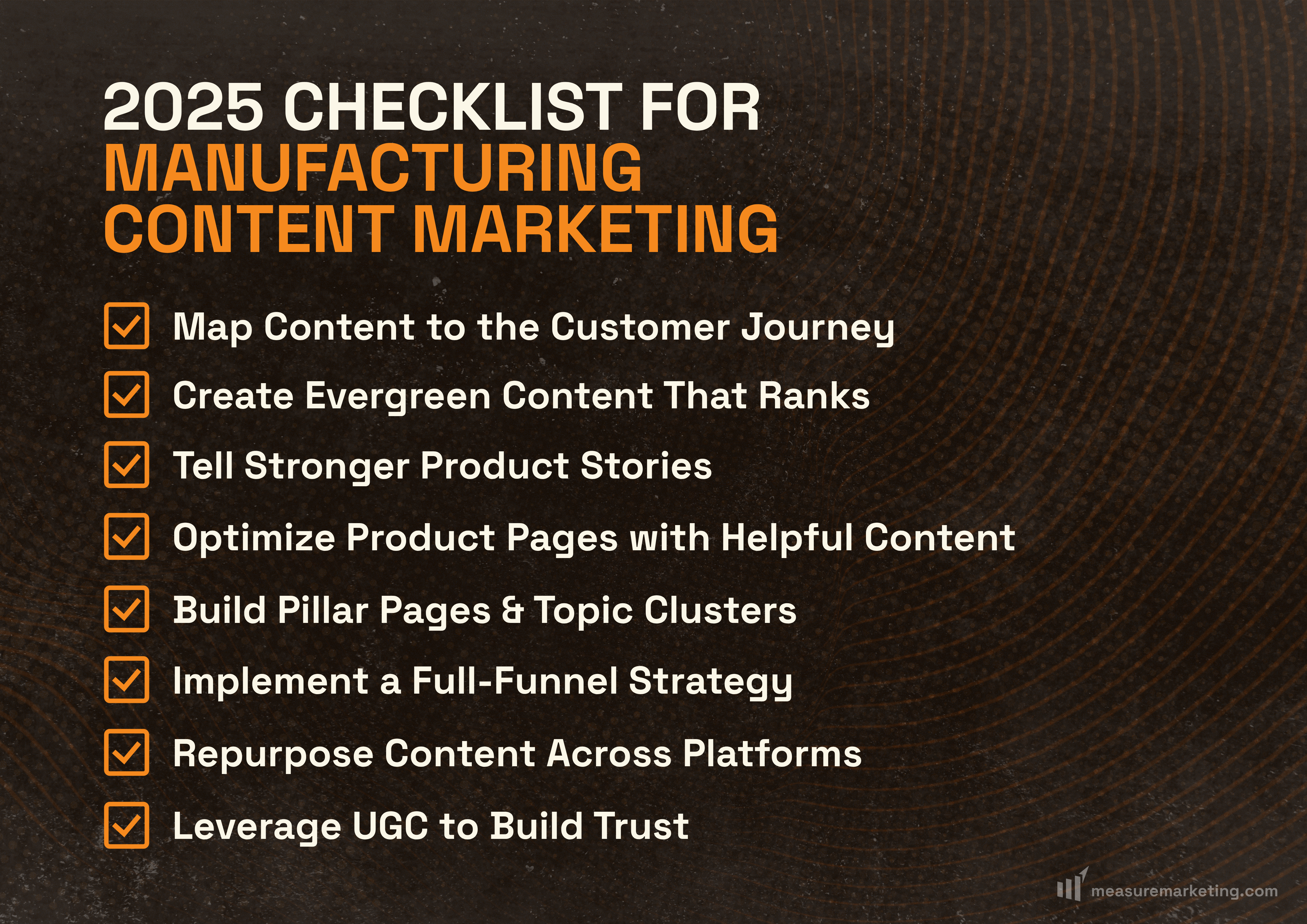
Optimize Product Pages with Helpful Content
Your product pages are bottom-of-the-funnel goldmines. Don’t treat them like static catalog entries. Enhance them with helpful content that overcomes final purchase barriers. Key manufacturing product page SEO tips include adding FAQs, short demo videos, customer testimonials, and downloadable spec sheets. Make it easy for a buyer to find everything they need to validate their decision.
Build Pillar Pages & Topic Clusters
To establish authority with search engines, adopt a pillar content manufacturing strategy. A pillar page is a comprehensive resource on a broad topic (e.g., “CNC Machining Efficiency”). This pillar is then supported by a cluster of more detailed articles that link back to it (e.g., “5 Ways to Reduce CNC Cycle Time,” “Choosing the Right CNC Coolant”). This organized structure signals your deep expertise to Google and helps you rank for competitive keywords.
Implement a Full-Funnel Strategy (TOFU, MOFU, BOFU)
A successful full-funnel content strategy for manufacturers ensures you have the right asset for every stage of the buyer’s journey.
- Top-of-Funnel (TOFU): Attract. Focus on broad educational content like blog posts, infographics, and industry trend reports that address high-level problems.
- Middle-of-Funnel (MOFU): Nurture. Offer deeper, solution-oriented content like case studies, white papers, and webinars to build a business case.
- Bottom-of-Funnel (BOFU): Convert. Provide decision-making assets like product demos, ROI calculators, and free consultations to close the deal.
Repurpose Content Across Platforms
Maximize your investment by repurposing high-value content. A single webinar can be transformed into a dozen different assets: a blog post summary, short video clips for LinkedIn, an audio podcast episode, and a series of quote graphics. This multi-channel approach extends the life and reach of your best ideas.
Leverage UGC to Build Trust
In B2B, social proof is paramount. User-generated content (UGC)—such as client testimonials, video reviews, and detailed case studies—is one of the most powerful tools in your arsenal. It provides authentic, third-party validation that is often more persuasive than any brand-produced content. Actively solicit and showcase this content to build a powerful foundation of trust.
The Shift Is Not Coming. It’s Here.
The shift to digital is undeniable. Manufacturers who embrace a strategic, buyer-centric content marketing approach will not only survive but thrive. By building trust through education, demonstrating expertise, and providing value at every touchpoint, you create a competitive moat that is impossible to replicate. This industrial content marketing checklist is your starting point.
Ready to transform your marketing into a revenue-generating growth engine? Connect with Measure Marketing today, and let’s design a go-to-market program that turns complex buyer journeys into measurable results.